Tackling a local public health challenge one tick at a time
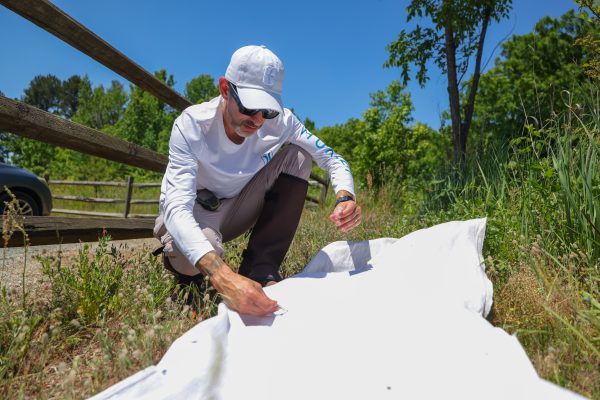
Every week, rain or shine, hot or cold, members of UNC Charlotte’s tick surveillance team return to the same spots in the same nature preserves to collect ticks and record weather conditions, specifically humidity, temperature and wind speed.
Since April 2025, under the direction of UNC Charlotte Public Health and Health Administration Associate Professor Rafael Vieira, public health and biology students have been collecting, identifying and testing ticks for pathogens that cause tick-borne diseases in humans and animals.
Until now, Mecklenburg County, North Carolina has relied on tick data compiled by outside groups that visit the area once a year to conduct field sampling. This type of sampling, which targets micro-geographical zones in a single day, doesn’t accurately represent which tick species are found throughout the county and at what density.
“Pinpoint sampling can’t measure the real public health risk,” Vieira said.
To collect better tick data on a regular basis, Vieira is partnering with Mecklenburg County Park and Recreation’s division of Nature Preserves and Natural Resources to conduct tick surveillance at Cowan’s Ford Wildlife Refuge and Latta Nature Preserve in Huntersville and eventually at 42 parks and greenways across the county.