Research aims to foster belonging for men in caring professions
Men are having a moment.
There are recent books (“Notes on Being a Man”), national TV news reports (“Boys to Men: Why America’s Sons Are Struggling”), documentaries (“Beyond Men and Masculinity”) and more highlighting the modern male experience that, for some, is causing loneliness, self-doubt and a crisis of masculinity.
Closer to home, two UNC Charlotte social work professors are going to study men who work in sectors mostly dominated by women such as K-12 education, health care, social services and public health. Their goal is to strengthen belonging, relationships and awe among men in Charlotte’s caring professions.
Males in these types of helping roles are facing uncertainty, the professors said, with many of them reporting thin mentorship pipelines, scarce role models and fragile peer networks. The study will promote ways to enhance individual well-being, reduce professional isolation and improve retention in jobs that are crucial to Charlotte’s future.
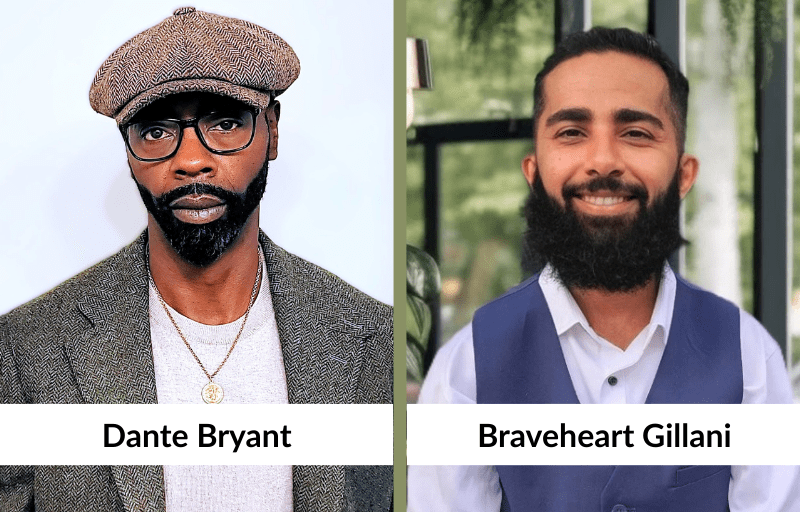
Assistant Professors Braveheart Gillani, Ph.D., and Dante Bryant, Ph.D., who teach in the School of Social Work within the College of Health and Human Services, are among the 10 UNC Charlotte faculty members who make up the seventh cohort of the Charlotte Urban Institute’s Gambrell Faculty Fellowship. The program, funded by the Gambrell Foundation, provides grants for short-term, faculty-facilitated research projects related to economic mobility in Charlotte.
Gillani and Bryant’s research project will aim to test effects on belonging, awe, loneliness and retention among men in Charlotte’s caring workforce in order to produce scalable implementation practices for health, education and human service organizations.
With Charlotte’s care sector employing tens of thousands of residents, even modest improvements in male belonging and retention can yield outsized benefits for patients, clients, students and co-workers, the researchers said.
The initial phase of the project will provide a baseline to identify where support is most needed within this population. The second phase will include a series of shared experiences among a cohort of local health care workers to cultivate authentic connection, mutual support and shared meaning. The aim is not a one-time event, but the development of relational bonds that counter isolation and strengthen engagement.
“If we can increase belonging and connection, we can reduce attrition. If we can help men experience their work as meaningful and socially supported, we strengthen not only their individual well-being but also the health care ecosystem in Charlotte,” said Gillani. “At its core, this project is about investing in the human infrastructure behind our caring professions and ensuring that those who care for others are supported in thriving.”
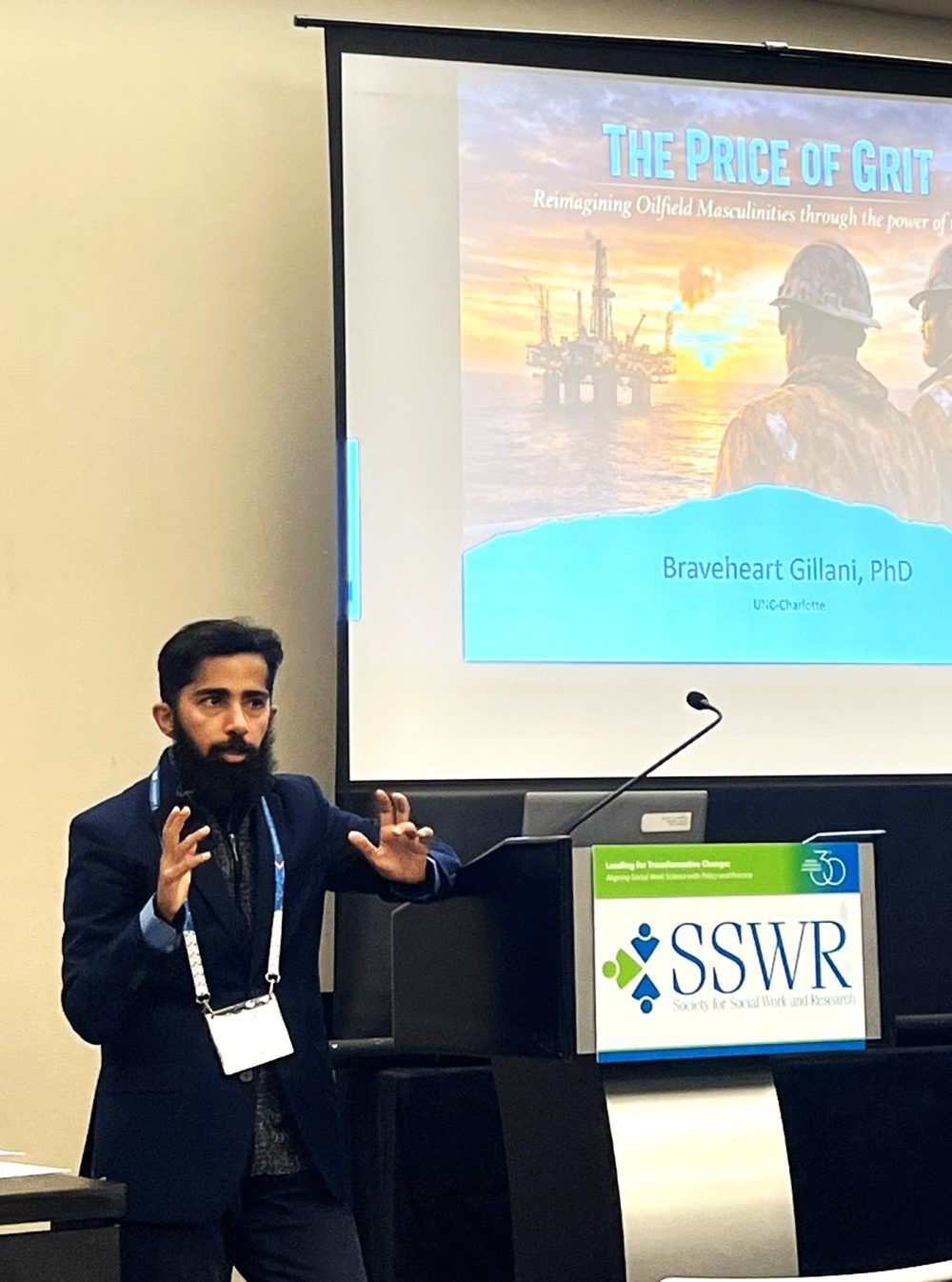
The idea for the project came from Gillani’s firsthand observations of increasing burnout, despair and isolation among men working in health care and other helping professions. “Many of these men entered their fields because they genuinely care about people, yet they often experience their work in isolation,” Gillani said. “I care deeply about the well-being and flourishing of men. For me, flourishing means much more than income or status. It includes belonging, connection, purpose and psychological health.”
Bryant, who has spent his entire career in social services, community organizing and community activism, has faced isolation in the workplace. “These are female-dominated spaces,” he said. “I’ve only had one male boss and I’ve never been in a professional environment that was male-dominated. You do have experiences of isolation.”
Awe-inspiring practices
The study will emphasize the power of “awe” to help reduce distress and support prosocial emotion.

“Research shows that experiences of awe can expand perspective and strengthen social connection. Awe helps people feel part of something larger than themselves and increases humility and prosocial behavior,” Gillani said. “I began to ask whether awe could serve as a leverage point for building connections among men in caring professions. This project grew from that question. I wanted to understand their lived reality in Charlotte and to test an intervention that could meaningfully support their well-being and connection.”
For Bryant, awe is what happens when we encounter something that is beyond our comprehension. “It’s something that unsettles what we thought we knew and causes us to have a moment of appreciation for the complexity and dynamic of something that is beyond us,” he said. “This project is largely about how we try to curate systems or patterns of engagement that can help facilitate that posture and corresponding experiences, which will contribute to retention.”
Starting small
According to the researchers, men in caring professions are a small but consequential share of Charlotte’s human-services workforce. Many have normalized the low number as simply the status quo.
“We rarely pause to question the cultural expectations and structural dynamics that contribute to that imbalance,” Gillani said. “I envision a future in which caring professions are honored socially and economically and in which people of all genders feel equally welcomed and supported within them. This project begins by asking what is happening locally and how men in Charlotte experience their roles in these professions.”
Read about each of the 2026 Gambrell Faculty Fellow projects