As AI sparks national debate, UNC Charlotte scholar Othelia Lee steps in with timely textbook
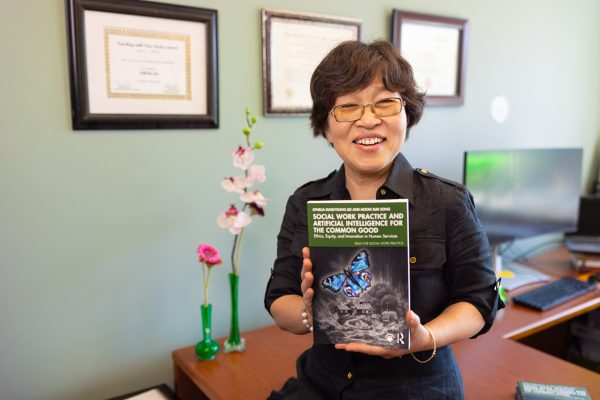
Social work Professor Othelia Lee had no clue one year ago when she started writing a textbook about artificial intelligence that by the time the book would publish on September 8, 2026 a national debate would be brewing about the ability of AI to exterminate humanity within the decade. Her guidance on AI ethics and equity in human services couldn’t have been timed any better.
Lee, a faculty member and researcher in the School of Social Work at UNC Charlotte’s College of Health and Human Services, is the lead author of “Social Work Practice and Artificial Intelligence for the Common Good: Ethics, Equity, and Innovation in Human Services,” the first university-level textbook to address how AI can be leveraged for the common good without reproducing systemic inequities.
The book offers interviews with experts, critical thinking questions, empowerment-focused activities, reflection prompts and support materials.
Though writing the textbook was a collaborative effort with co-author Moon Sun Song, Lee had the primary role of shaping the vision, structure and content of the manuscript and served as the sole author of eight chapters.
In this Q&A, Lee talks about her reasons for writing the textbook, some of the issues surrounding AI and how social workers will be using AI in the future.
Why do you think there haven’t been any other textbooks on this particular subject until now?
AI is still an emerging field, and its rapid evolution has made it difficult for educators and practitioners to keep pace. We are living through a historic moment in which AI is accelerating change across nearly every sector of society. AI is pushing us to work faster, think more deeply and reimagine what may be possible.
When designed with humanity at its center, AI has the potential to create a more equitable world. Imagine a future in which people of every age, income level, country, educational background, gender, sexual orientation and religion have equal access to vast bodies of knowledge through AI. Social workers, grounded in values of justice and human dignity, are uniquely positioned to help ensure that AI becomes an equalizer rather than a divider.
At the same time, AI is undeniably a double-edged sword. Without thoughtful oversight, it could widen wealth gaps, deepen educational inequalities and undermine democratic institutions. Concerns about job displacement and the future of work are no longer distant hypotheticals. These questions are shaping public conversations right now.
That urgency is one of the reasons this textbook is needed today.
What led you to take on the topic of social work, AI and the common good?
Several experiences inspired me to write this book.
In the spring of 2025, the world witnessed how fragile institutions can become when information systems are disrupted. USAID, a cornerstone of global development efforts, was effectively dismantled within days through actions as simple as restricting access to email and communication networks. It was a powerful reminder that when technology fails, or is intentionally disrupted, entire systems of support can be silenced almost overnight.
Later that year, I facilitated a Collaborative Online International Learning session focused on AI in human services with graduate social work students from China, Indonesia, Mexico and the United States. During an anonymous survey, every student reported regularly using AI tools. Even more striking, nearly one-third said they consulted AI chatbots about personal concerns.
Yet very few had received formal instruction on the ethical use of AI within their social work education. That gap is profound. Students are already integrating AI into their everyday lives, but often without guidance on responsible, ethical and culturally responsive use. As AI becomes increasingly embedded in assessment, documentation, service navigation and community organizing, critical AI literacy is no longer optional. It is essential to the future of the profession.
Who is the audience for the textbook?
The primary audience is graduate social work students and recent graduates entering professional practice. However, the book was intentionally written to reach a much broader audience. Through critical thinking questions, empowerment-focused activities, reflection prompts, expert interviews and supplemental learning materials, the text is relevant to students in social work, public policy and human services programs.
The book will also appeal to practitioners working in nonprofit organizations, government agencies and public service settings, as well as faculty members interested in strengthening AI literacy within their courses.
Why is this the right time for this textbook?
I do not consider myself an AI expert, nor am I a proponent of AI. However, my experiences have made one thing unmistakably clear: Social workers must be prepared to understand, question and help shape the technologies that increasingly influence people’s lives.
Literacy empowers. Critical AI literacy empowers social workers and the communities they serve to engage with technology in ways that uphold justice, dignity and human rights. That is why this is the right time for a textbook like this.
Lately, there’s been a national debate about the dangers of AI and how it may threaten humanity’s survival. Does the textbook explore this or similar issues?
Absolutely. The textbook encourages readers to engage critically with both the opportunities and risks of AI.
History reminds us that social innovation can either challenge inequality or reinforce it. During the Progressive Era, Jane Addams (a pioneer of the social work profession) envisioned a society in which all people could benefit from the common good. Today, AI presents a similar crossroads. It holds tremendous transformative potential, but whether it expands opportunity or deepens inequity depends on how we design, regulate, teach and use it.
The book explores many of these tensions, including bias, automation, accountability and ethical decision-making. Rather than offering simple answers, it encourages readers to think critically about the future they want to help create. As social workers, we have a responsibility to ensure that AI serves humanity and the common good rather than the other way around.
Microsoft co-founder Bill Gates said, “AI will either be the greatest equalizer ever invented, or the worst source of injustice.” How did you tackle this concern in the textbook?
That quote captures one of the central themes of the book.
We weave equity, human rights and the National Association of Social Workers’ Code of Ethics throughout every chapter. Rather than simply teaching readers how AI works, we ask deeper questions: Who benefits from these technologies? Who might be harmed? And how can social workers intervene to promote fairness and justice?
The textbook encourages practitioners to become active designers, advocates and critical consumers of technology rather than passive adopters. We devote significant attention to bias, ethical dilemmas and community-based technology design because these issues directly affect the individuals, families and communities social workers serve.
What are some of the ways social workers are using AI now?
AI use in social work is evolving rapidly, and comprehensive data on current practice remains limited. Rather than speculate, I prefer to rely on evidence.
To help address this knowledge gap, my School of Social Work colleague Suzanne Boyd and I recently received a summer fellowship from the College of Health and Human Services. Through this project, we will interview national experts about the current use of AI in social work practice and develop a structured university-industry collaboration model designed to strengthen workforce readiness among social work graduates.
As the field continues to evolve, we hope this research will provide a clearer picture of how AI is being used and where future opportunities and challenges may emerge.
What do you see for the future of AI in the social work field?
The possibilities are significant.
Machine learning systems may be able to analyze thousands of historical client cases to identify which services are most likely to benefit specific individuals based on past outcomes.
Large language models could review extensive case documentation and identify recurring patterns, such as housing instability, social isolation, symptoms of depression or suicide cases that might otherwise go unnoticed.
In child welfare settings, computer vision tools could assist housing inspectors by analyzing photographs and flagging potential safety concerns such as exposed wiring, mold or structural hazards.
Socially assistive robots may help older adults by providing medication reminders, guiding light exercise routines and reducing loneliness through conversation and companionship.
Of course, these innovations must always be accompanied by ethical safeguards, human oversight and a commitment to protecting client rights and dignity.
What surprised you while researching the book?
One pleasant surprise was discovering examples of genuinely human-centered AI.
Lately much attention has been given to the dangers of deepfake technologies, and rightly so. These tools can create significant risks for individuals and communities. Yet I also found examples of how the same technologies can be reimagined for protection and empowerment.
What’s the meaning behind the book’s cover showing a colorful butterfly floating above a black-and-white landscape?
The butterfly on the cover, drawn by my niece, represents the butterfly effect: the idea that small actions can create meaningful and lasting change. In many ways, that reflects the work of social workers. A single intervention, conversation or act of support may seem small in the moment, but its impact can ripple throughout a person’s life for years to come.
The black-and-white landscape reflects many of the challenges facing our world today, including climate change, global conflict and growing economic inequality. Against that backdrop, the colorful butterfly symbolizes hope, resilience and transformation. Like the butterfly, social workers emerge as change agents. Even in times of uncertainty and crisis, they help individuals, families and communities move toward healing, opportunity and a more just future.
Written by Othelia Lee and Pam Davis